
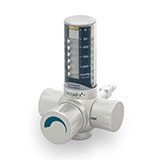
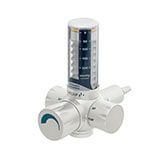
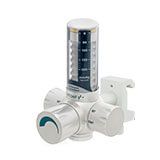
MEDAP S VAC INT
- Manufacturer
- ATMOS
- Category
- Medical clinics, Respiratory care and suction
- Application area
- Respiratory care
Tapping unit for intermittent aspiration
Description
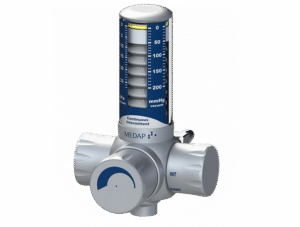
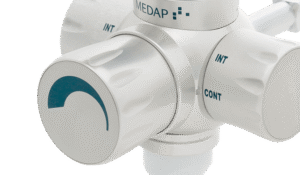
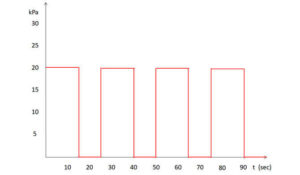
MEDAP S VAC INT Lightens the workload and offers a high level of safety Intermittent aspiration has become increasingly important in recent years. For subglottic aspiration in particular, intermittent suction offers a number of advantages over conventional, continuous suction. The MEDAP S VAC INT is the first intermittent aspiration tapping unit from ATMOS. It can generate a maximum vacuum of –26 kPa. This tapping unit can be operated either continuously at a high flow rate of 60 l/min or intermittently at a flow rate of 9 l/min. Its suction to non-suction ratio is approximately 15:10 seconds. Applications Intensive care unit Easy operation The large control valve allows you to set the desired vacuum precisely and thus assign the functions easily. Excellent visual monitoring Large, clear numbers in kPa and mmHg combined with a precise display of the current vacuum ensure excellent readability. Pneumatic timer A pneumatic timer ensures a constant suction to non-suction ratio of 15:10 seconds, entirely without electric power. FAQ What is 'ventilator-associated pneumonia'? Ventilator-associated pneumonia (VAP) is a type of pneumonia that can occur in ventilated patients. It is the most common fatal nosocomial infection. According to current studies, the incidence is 13 percent. For the first five days of ventilation, the incidence is 3 percent per day, then 2 percent per day up to day 10, and 1 percent per day from day 10. Ventilator-associated pneumonia increases the length of hospital stays by about 6–9 days. What is the prerequisite for carrying out subglottic aspiration? Subglottic aspiration is only possible if the endotracheal tube or the tracheal cannula has a lumen for suction that is above the cuff. Which patients benefit from subglottic aspiration? Subglottic aspiration is recommended especially for ventilation lasting more than 72 hours. Several studies and meta-analyses have shown that the incidence of pneumonia in these patients could be lowered by up to 50 percent. Why isn’t it possible to suction as needed like it is with bronchial aspiration? In the case of bronchial aspiration, the nursing staff hears when suction is required. Whether and when secretion has accumulated above the cuff cannot be heard. Since the amount of secretion produced varies depending on the patient, you do not know when it is time to suction. What is the advantage of intermittent suction over continuous suction? With continuous suction, there is a greater risk that the lumen of the cannula will attach to the tracheal mucosa and cause damage. Why can’t the vacuum connection tube to the septic fluid jar be connected directly to the MEDAP S VAC INT? In accordance with the international standard ISO 10079 for medical suction equipment, the use of a hydrophobic overflow protection device and a bacterial filter is mandatory. The MEDAP S VAC INT has the same connection as the MEDAP S VAC and the MEDAP S AIR. That means the same adapter, and therefore the same hydrophobic bacterial and viral filter, can be connected to the MEDAP S VAC INT as to the other two tapping units.
- Easy operation The large control valve allows you to set the desired vacuum precisely and thus assign the functions easily.
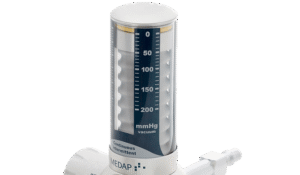
- Excellent visual monitoring Large, clear numbers in kPa and mmHg combined with a precise display of the current vacuum ensure excellent readability.
- Pneumatic timer A pneumatic timer ensures a constant suction to non-suction ratio of 15:10 seconds, entirely without electric power.
Specifications
| Gas type | Vacuum |
|---|---|
| Suction capacity | 60 l/min (cont.) 9 l/min (int.) |
| Max. vacuum | –26 kPa –260 mbar |
| Vacuum control range | 0 up to –26 kPa |
| Connection to CGS / gas pin | Wall: DIN, BS, equipment rail |
| Nominal pressure, gas supply | –100 to –60 kPa |
| Dimensions (H x W x D) | 170 x 114 x 177 mm |
| Weight | 784 g |
Variants
| DIN | DIN |
|---|---|
| BS | BS |
| Equipment rail | Equipment rail |
| Mechanical overflow protection | Mechanical overflow protection |
| Hydrophobic bacterial and viral filter | Hydrophobic bacterial and viral filter |
| MEDAP Connection Tubes | MEDAP Connection Tubes |